
Mm Ruler Printable
Need a millimetre ruler right now? Choose the length and style, print at 100% and check the 100 mm test bar against a real ruler. There’s also a tape measure you can cut out and glue together, and a quick practice game for learning to read millimetres.
- Free to use
- No sign-up
- Runs in your browser
Millimetre ruler maker
Practice: read the ruler
Printable Ruler Pack
All 6 PDFs are free individually. The optional $3 ZIP adds 3 editable Word documents and an Excel measurement log. Ruler PDFs and their markings are not editable; the Excel log has no automatic calculations.
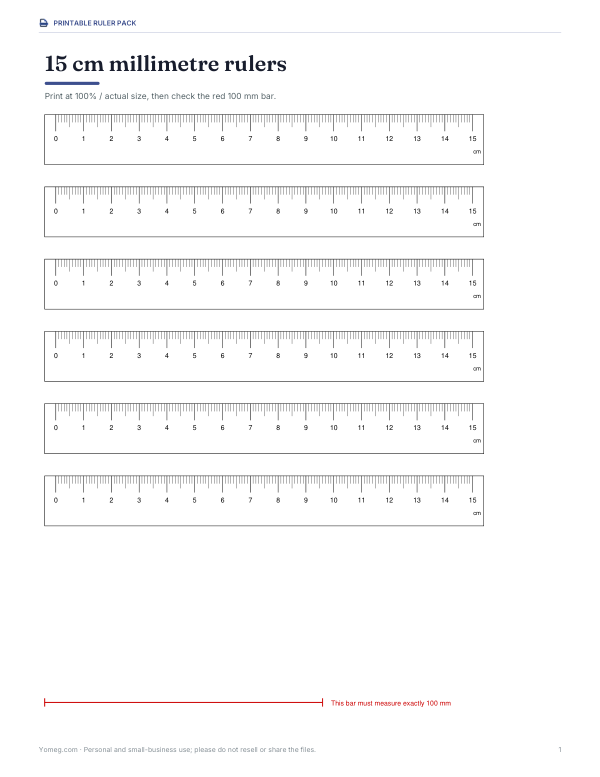
- 15 cm millimetre rulers (PDF)
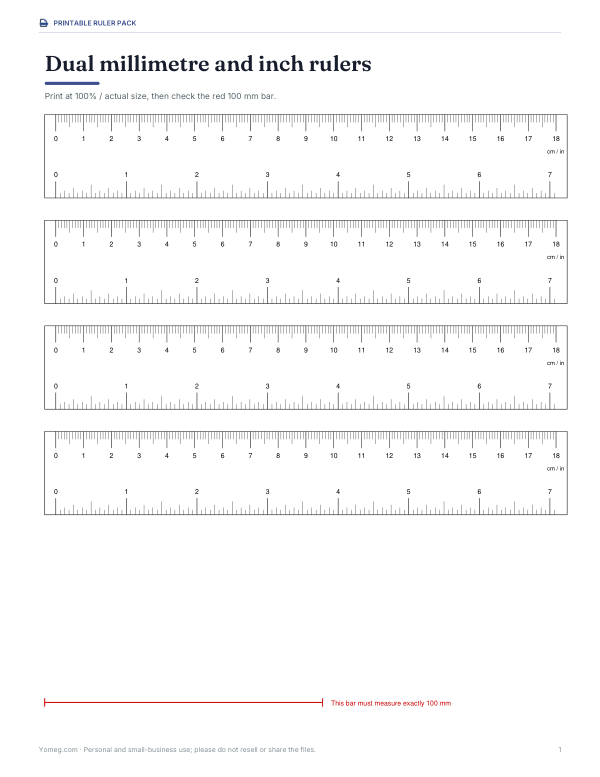
- 18 cm dual mm/inch rulers (PDF)
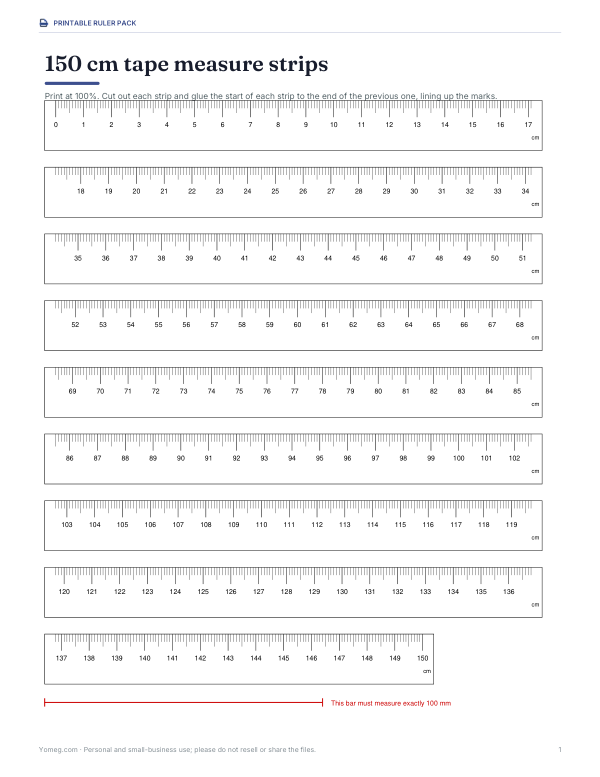
- 150 cm tape with numbered joins (PDF)
- Reading practice with answers (PDF/DOCX)
- mm-inch reference (PDF/DOCX)
- Manual measurement log (PDF/DOCX/XLSX)
Formats: PDF, DOCX, XLSX. Instant download after payment (link valid 72 hours, up to 5 downloads). AI-assisted: the templates were drafted with AI help and reviewed and laid out before publishing.
$3.00 USD, one-time 10 resource files + README (11 files total)
- Instant download
- 7-day refund
- Secure checkout by Stripe
7-day money-back guarantee. Full refund within 7 days of purchase, even after you download.
Free sample: MM Inch Conversion (PDF, 62 KB)
Full refund within 7 days — see the refund policy and license.
Free printables
All 6 PDFs are free individually (7 pages). The optional ZIP adds 3 editable Word documents and an Excel measurement log; it does not add extra ruler designs.
 Printable Millimeter Ruler Reading Worksheet
 Printable mm to Inch Chart
 Printable Measurement Log Sheet
How to print a ruler at true size
- Choose the ruler length, style and paper size above.
- Press Print and set scaling to 100%, “Actual size” or “None” — not “Fit to page”.
- Measure the red 100 mm check bar with a real ruler. A bank card is 85.6 mm wide, not 100 mm; do not match it to the whole bar.
- If the bar is off, check the printer settings and try again; don’t trust the ruler until it matches.
- Glue the printed ruler to card stock and cut it out for a sturdier tool.
Printer accuracy varies. Verify the 100 mm bar before use; this printable is for crafts and quick checks, not precision work.
Reading a millimetre ruler
On a metric ruler, the long numbered lines are centimetres, the medium line halfway between is 5 millimetres, and each small line is one millimetre. To read a length, count the whole centimetres, multiply by ten, and add the small marks: 4 whole centimetres and 7 small marks make 47 mm, or 4.7 cm. For half-millimetre readings, estimate halfway between two marks. The practice game above picks random points so you can check your reading.
Worked example
A jeweller needs to check bead sizes, so they print four 15 cm mm-only rulers on A4 with 5 mm labels, measure the red check bar at exactly 100 mm, and glue one ruler to card. A sewer printing the 150 cm tape on US Letter gets nine strips; after cutting and gluing each under the previous strip’s tab, they check the finished tape at 50 cm and 100 cm against a yardstick before measuring for a dress.
mm, cm and inches
| Metric | Inches (approx.) | Everyday example |
|---|---|---|
| 1 mm | 0.04 in (about 1/25) | Thickness of a bank card is about 0.76 mm |
| 5 mm | 0.2 in | Pencil lead holder width |
| 10 mm = 1 cm | 0.39 in | Width of a fingernail |
| 25.4 mm | 1 in | Exactly one inch by definition |
| 100 mm = 10 cm | 3.94 in | Width of a smartphone |
| 300 mm = 30 cm | 11.8 in | A standard school ruler |
The dual ruler shows inches in sixteenths on the lower edge, so you can compare directly.
Checking your printer’s accuracy
Printers can shrink or stretch a page slightly, and the error is not always the same across and down the page. Measure the 100 mm check bar, then measure a ruler printed in the other direction (a landscape page turns it 90°). If one direction is off by more than about half a millimetre per 100 mm, look for a “scale”, “fit” or “borderless” option that is still switched on, or try a different application — some PDF viewers apply their own shrink-to-fit. For a quick sanity check without another ruler, a standard bank or ID card is 85.6 mm wide and 53.98 mm tall.
Making a sturdier ruler
- Print on heavier paper or card stock (160–200 gsm) if your printer can feed it.
- Or glue the printed ruler to a strip of card or thin plywood with a glue stick, pressing out air bubbles.
- Cover it with clear packing tape or laminate it to protect the markings.
- Cut along the edge closest to the zero mark so the scale starts right at the end, or leave a margin and measure from the zero line.
- For the tape measure, glue the strips to ribbon or twill tape so it bends around a body or a curved object without tearing.
Teaching children to measure
Start with whole centimetres, then introduce millimetres as the “little marks”. Ask children to measure everyday things — an eraser, a coin, a crayon — and write both the mm and cm values, such as 38 mm = 3.8 cm. The practice game is useful for quick drills: read the arrow, type the value in millimetres and check. Once millimetres are secure, the dual ruler helps show why 2.54 cm makes an inch.
Uses for printable rulers
- Measuring beads, screws and small parts.
- Craft, scrapbooking and paper projects.
- Teaching children to measure in mm and cm.
- A tape strip for body and sewing measurements.
- Checking ring sizes and jewellery dimensions.
- Quick checks when a ruler isn’t at hand.
Privacy
Rulers are drawn in your browser; nothing is uploaded.
Frequently asked questions
How do I print a ruler at actual size?
Set printer scaling to 100% or “Actual size”, then check the 100 mm bar.
How many mm are in a cm?
10 millimetres.
How do I read millimetres on a ruler?
Count whole centimetres × 10, then add the small marks.
Can I print a tape measure?
Yes — choose “Tape strips” to print 150 cm in strips to glue together.
Why is my printed ruler slightly off?
Scaling may be on, or the printer may be slightly inaccurate; recheck the settings.
What can I use to check a printed ruler?
Use a real ruler to check the 100 mm bar. A standard card is only 85.6 mm wide and cannot match the whole bar.
Can I print a ruler longer than the page?
Use the tape strips, which join end to end up to 150 cm.
How do I read half millimetres?
Estimate halfway between two small marks, for example 23.5 mm.
Which paper size should I choose?
Pick the paper loaded in your printer. Longer rulers switch to landscape when the ruler and margins need more width.
Is it accurate enough for engineering?
No, use a certified ruler or caliper for precision work.